
Stranger Things Character Arcs Broken Down: Who Dies in Season 5?
A Full Character Map of Where They Started and Where They Are Headed
Hawkins covered in ash as rifts to the Upside Down open, Stranger Things Season 4
When Stranger Things left us at the end of Season 4, The boundaries between Hawkins and the Upside Down had finally ruptured. The world as they know it had begun to rot under Vecna’s rule. As the fiery gates to hell began to tear through Hawkins, smoke filled the air and ash drifted like snowfall while the characters stood facing a reality so bleak it felt beyond saving.
Season 5 is the final chapter, the last adventure in the place where everything began. The Duffer Brothers have always insisted they planned the major emotional arcs long before the show became a global phenomenon, and the way they have built these characters through trauma, love, guilt, and fate feels far too intentional to ignore.
Stranger Things may be a supernatural horror series, but at its heart the show revolves around relationships: families built from grief, friendships patched together after loss, and teenagers who learn the cost of growing up in a world that keeps asking them to fight. The Duffers have developed these tragic arcs methodically throughout the show, planting seeds as early as Season 1 that now feel like grim foreshadowing. To understand who might survive the final season, we have to go back to the beginning and map every character’s path through the lens of horror archetypes.
Below is a full character map, supported by examples throughout the series, tied to classic horror tropes, and concluded with final death predictions.
Dustin, Lucas, El, and Mike searching for Will, Stranger Things Season 1
Mapping Characters in Horror: Why It Matters
Character mapping in horror is the backbone of emotional storytelling. Horror is not effective because something frightening happens, but because something meaningful happens to characters we care about.
Think about it., horror is never just about the monsters, what keeps us engaged is the characters we lose along the way. A good horror will be sure to methodically plan out these deaths to carry a very much calculated emotional weight for the viewer. Think of Bob in Season 2, Billy in Season 3, or Eddie in Season 4. Each death was detrimental to resolve an arc and deepened the story.
This is where mapping becomes useful as we see our beloved characters begin to fall into these classic horror tropes that can ultimately be used to predict their very fate. Stranger Things is no exception, from The Final Girl, the Doomed Protector, the Martyr, the Loner, to the Reformed Jock. Stranger Things plays into these tropes constantly.
Now, using these principles, here is where every major character started, how they developed across the series timeline, and where their arc naturally points in Season 5.
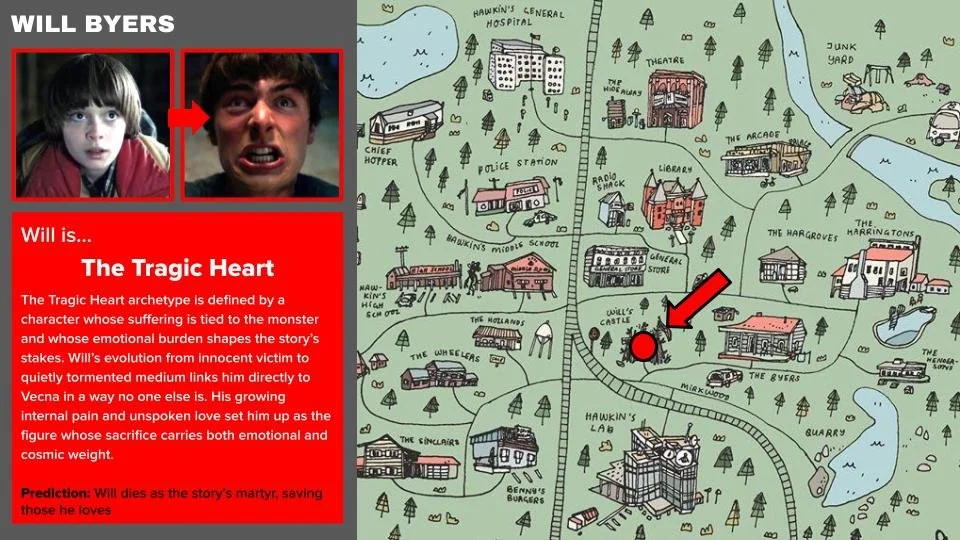
Will Byers: The Tragic Heart
Will Byers trapped in the Upside Down, Stranger Things Season 1
Season 1: The Chosen Victim
From the very beginning, Will Byers is positioned as the emotional core of Stranger Things. His disappearance in Season 1 not only serves as a plot catalyst, but maps out the foundation of the entire series. When the boys sit around the Dungeons & Dragons table in the first episode, Will barely stands out. He is quiet, sensitive, and contemplative. These qualities make him a perfect target for the Upside Down, a world that preys on emotional vulnerability rather than physical weakness. The Mind Flayer does not choose him by accident. When he is dragged into the alternate dimension, the show establishes him as the “chosen victim,” a classic horror archetype rooted in stories where the innocent child is claimed by an ancient force. The Exorcist, The Ring, even It, all use the same motif. Stranger Things follows suit, immediately placing Will in that same lineage.
Season 2: The Possessed Medium
Season 2 deepens this archetype. Will does not simply return from the Upside Down. He comes back infected by it. The Mind Flayer uses him as a vessel, speaking through him in cryptic phrases, turning his drawings into maps of Hawkins, and physically tormenting him with visions of shadow and fire. The possession storyline leans heavily into supernatural horror language. His trembling body, his trance-like states, and the famous heater scene where Joyce tries to exorcise the entity feel like direct nods to possession horror. Will becomes the tragic medium, a boy forced to endure what the adults cannot comprehend. By the time he screams “He likes it cold,” it is clear his fate is not tied to normal childhood development but to a cosmic battle far beyond his control.
Season 3: The Lost Boy
By Season 3, the horror shifts. The possession is gone, but its aftermath lingers in quieter, more emotional ways. Will is no longer in sync with his friends. His desire to play D&D while the others drift into romance symbolizes something deeper: he is emotionally stranded between childhood and forced maturity. Here we see the show shift gears, putting the supernatural horror elements on the back burner as we start to transcend into psychological horror. Will feels invisible and displaced. His breakdown in the rain when Mike and Lucas tease him is one of the most painful scenes because it shows a boy grieving the childhood that was stolen from him. The real monster of Season 3 for Will is loss of belonging.
Season 4: The Heartbreak Breaks Open
Season 4 is the peak of Will’s emotional arc. The van monologue where he encourages Mike, while crying silently and looking away, is the culmination of years of repression. For the first time, the audience sees clearly that Will’s internal conflict is not solely about trauma from the Upside Down, but also about love he cannot express. This is the heartbreaking intersection of cosmic and emotional tragedy. Will has loved Mike for years, and the show confirms that this unspoken love fuels much of his quiet suffering. When he touches the back of his neck in the finale and feels the connection to Vecna again, the arc comes full circle. The boy chosen by the monster from Season 1 is still tethered to him. The tragic heart has never truly been freed.
The Martyr Archetype
Because of these layers, Will aligns with horror’s classic Martyr archetype. The Martyr is the character whose emotional vulnerability becomes the key to defeating evil. They often die in an act of tragic sacrifice, not because they are weak, but because they are able to understand the monster more deeply than anyone else. In films like The Haunting, The Mist, or The Green Mile, the Martyr’s death is the emotional climax. Stranger Things appears to be setting Will up for the same fate. His visions, his psychic link to the Upside Down, his unresolved love for Mike, and his emotional sensitivity all point toward one inevitable ending. If Season 5 brings the final confrontation with Vecna, Will is the only one who can face him directly. The story began with Will, and it may end with him giving his life to end the cycle.
Season 5 Prediction: Will’s Tragic Sacrifice
Will’s predicted death is not random. It is the completion of his archetype. The Tragic Heart dies so everyone else can live. His love for Mike, his bond with Eleven, and his lifelong connection to the supernatural forces of Hawkins all make him the central sacrificial figure. Season 5 may finally give Will agency, but the cost will likely be everything.

Mike Wheeler: The Reluctant Hero
Mike reunites with Eleven after a government ambush, Stranger Things Season 4.
Season 1: The Earnest Boy-Hero
Mike Wheeler has always functioned as the group leader. In Season 1, he is bold, noble, and loyal, willing to risk everything for both Will and Eleven. He stands up to Hopper, he hides El in his basement, and he jumps off a cliff assuming he might die if it means protecting a friend. These early choices establish Mike as the earnest boy-hero archetype, the type commonly found in 80s horror and adventure films like The Lost Boys and The Goonies. His heroism is raw and instinctual, he thrives off his own empathy rather than pure strength.
Season 2: Grief, Loyalty, and Emotional Imbalance
Season 2 exposes a flaw in that heroism. Mike shifts into a darker emotional space as he becomes consumed with grief after Eleven disappears, and therefore closes himself off from the group. His emotional world narrows to a single point of fixation: finding her again. But even in this grief, Mike does not turn away from Will. He becomes fiercely protective of him, staying by his side the entire season, comforting him during visions, and treating Will’s safety as the mission that holds the Party together. What Season 2 truly reveals is the beginning of Mike’s emotional imbalance. He loves intensely, but his grief, fear, and loyalty collide in ways he doesn’t know how to manage. When Eleven finally returns, his anger and defensiveness reveal Mike’s deepest flaw as he struggles to process multiple emotional truths at once. He can be devoted to Will, he can ache for Eleven, but he can’t articulate or navigate both at the same time. This is the early seed of the emotional blindness that will define his later arc.
Season 3: Tunnel Vision
Mike’s tunnel vision is fully evident by Season 3, driving much of his emotional behavior. His relationship with Eleven becomes so central to him that he loses touch with the group. His inability to communicate maturely causes conflict with both El and the Party. He lies, he avoids confrontation, and he has trouble speaking from the heart. Mike is still heroic, but he has begun to lose clarity. Horror stories often use this exact shift. The character once destined for heroism becomes uncertain and compromised, a figure whose fate now lies in one of two directions: growth or collapse.
Season 4: Emotional Blindness at Its Peak
By Season 4, Mike’s emotional avoidance reaches its peak. Mike spends most of the season dodging conversations with Will and failing to understand Eleven’s internal struggles. His letter to El is forced and superficial. His inability to see Will’s pain in the van scene reveals the emotional blindness the Duffers have been building toward. Mike Wheeler loves fiercely, but he does not understand the emotional worlds of the people who love him.
The Reluctant Hero Archetype
Because of this, Mike aligns with the Reluctant Hero archetype. In horror, this character survives not because they are the strongest, but because trauma forces them into clarity. Films like The Babadook and The Ring use similar arcs. The protagonist is flawed, emotionally hesitant, and reluctant to fully accept their role until the final act forces a transformation.
Season 5 Prediction: Surviving at a Cost
In Season 5, Mike will likely survive, but the cost will be life-changing. If Will dies saving him, Mike will finally be forced into a confrontation with the emotional truths he has ignored. His arc points toward painful growth rather than literal death. The Reluctant Hero is rarely killed. Instead, they live on with the weight of what they failed to see sooner. Mike may ultimately step into true leadership, but it will come from tragedy rather than triumph.
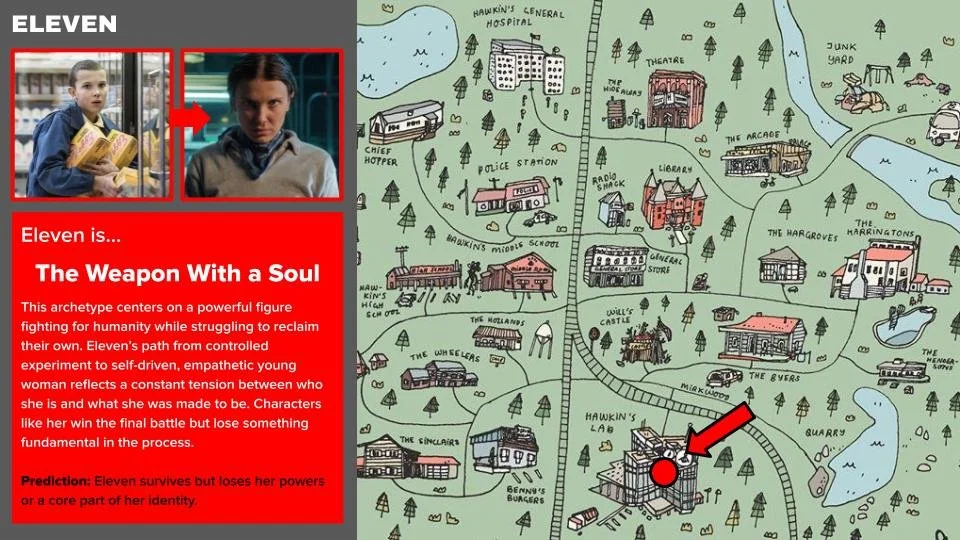
Eleven: The Weapon With a Soul
Eleven using her powers to confront the boy’s bullies, Stranger Things Season 1
Season 1: A Child Built as a Weapon
Eleven embodies one of horror’s most enduring archetypes: the supernatural weapon who longs for humanity. From Carrie to Firestarter, the archetype centers on a young girl with extraordinary powers who wants freedom from the violence she was born into. Stranger Things frames this dilemma from the first moment we see Eleven running barefoot through the woods with a shaved head and fear in her eyes.
Season 1 positions El as both a child and a weapon. She destroys the Demogorgon in a moment of desperate sacrifice, but she also longs for the simple comforts she sees in Mike’s basement. Her arc is defined by a relentless battle as she yearns for tenderness amid the destruction that follows her.
Season 2: The Search for Identity
Season 2 focuses entirely on identity. Eleven runs from Hawkins, searches for family, and confronts her own rage. The episode where she meets Eight reveals the danger of leaning into her violent side. The show uses this tension to develop her internal conflict. Is she a person or a tool?
Season 3: Losing Her Powers, Finding Herself
In Season 3, El loses her powers. This is one of the most important moments in the series because it forces her to exist without her supernatural identity. Her fight with the Mind Flayer in the cabin leaves her powerless in a way she has never experienced. The loss is both emotional and existential. It strips away the weapon archetype and leaves only the girl underneath.
Season 4: Trauma, Memory, and Moral Reckoning
Season 4 returns her to trauma. She relives her past, confronts Brenner, and experiences the horror of being blamed for violence she did not cause. The Nina Project storyline becomes a psychological descent. She is forced to question her memories and her own morality. When she faces Vecna in the final confrontation, she does so as a fusion of both identities: the weapon and the girl who wants to choose love.
The Weapon With a Soul Archetype
Horror archetypes involving supernatural children often end in sacrifice or isolation. But Eleven’s arc has always resisted fatalism. She is destined not to die but to carry the trauma of survival.
Season 5 Prediction: Survival With Consequences
In Season 5, she will likely live, but she will be broken. The final choice she makes may involve rejecting her powers entirely or stepping away from the world she saved. The Weapon With a Soul rarely dies. Instead, she becomes a symbol of both hope and the cost of violence.

Max Mayfield: The Walking Wound
Season 2–3: The Outsider and the Toll of Billy’s Death
Max enters in Season 2 as the outsider. Her humor, defensiveness, and fear of vulnerability make her instantly compelling. Max’s archetype is rooted in the Scream tradition of the wounded girl who carries more trauma than she lets on. Her relationship with Billy is the emotional anchor of that pain. When Billy dies in Season 3, sacrificing himself to save her, Max’s guilt becomes the core of her arc.
Season 4: Grief, Vecna, and the Walking Wound Archetype
Season 4 elevates Max to the center of the story. Her grief is portrayed with stark realism. She isolates herself, writes letters to the people she loves, and avoids Lucas even though she clearly cares for him. The show frames her as the Walking Wound, a character whose trauma becomes literal prey for the monster. Vecna targets her not because she is weak, but because she is drowning in unresolved grief. The “Running Up That Hill” sequence is not just a musical moment. It is the psychological climax of her arc. Max confronts her trauma, but she has yet to defeat it.
Season 5 Prediction: A Survivor Who May Never Fully Heal
Her near-death in the finale makes her Season 5 fate one of the most unpredictable. The survivor shell trope from films like Nightmare on Elm Street 3 suggests that even if Max lives, she may never fully return to herself. Her body is alive, but her mind and spirit could remain fractured. This makes her a wildcard. Max may survive the final season physically, but she could lose herself in a more devastating emotional way.
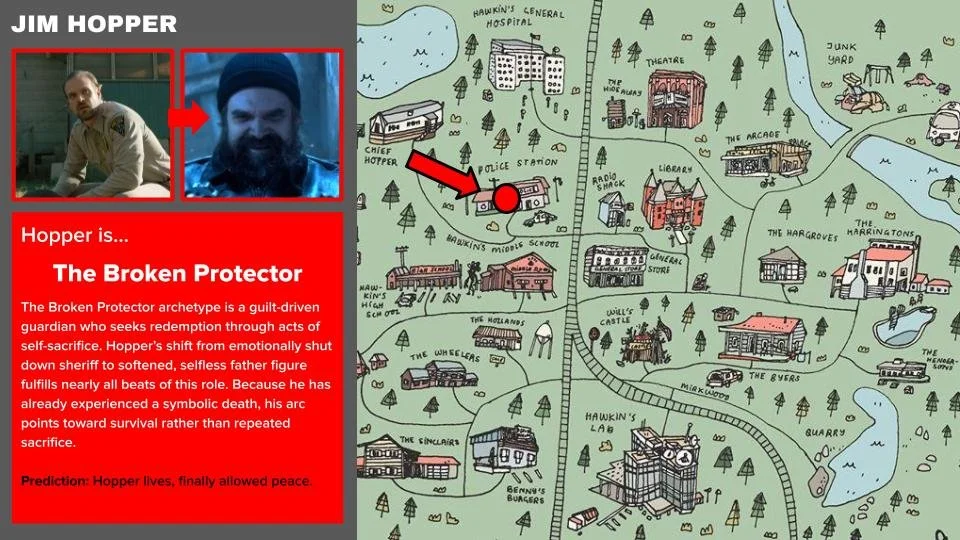
Jim Hopper: The Broken Protector
Hopper tormented and imprisoned in Russia, Stranger Things Season 4
Hopper begins the series in Season 1 as a grieving father drowning in alcohol and apathy. His daughter’s death shatters him long before the story begins. This positions him firmly within the Broken Protector archetype, a horror trope where the guilt-ridden father figure must redeem himself by saving a vulnerable child. When Hopper meets Eleven, the arc begins to repair.
Season 2 softens him. He becomes overprotective, grounding El for her safety, struggling between fear and love. His fight with the Mind Flayer at the end of Season 3 is framed like a classic protector’s sacrifice. The apparent death in the blast is the moment his archetype peaks.
Season 4 transforms him again. The Russian prison arc shows Hopper enduring torture, starvation, and hopelessness, yet he survives. The flame-thrower scene against the Demogorgon is a brutal metaphor of everything he has become.
Season 5 Prediction: The Protector’s Final Sacrifice
Hopper is a survivor, but he is also exhausted. The Broken Protector archetype often ends in one final sacrifice. The fact that Hopper already “died” once suggests the final season may make the sacrifice real. His story has always been about saving Eleven. Season 5 may be the final opportunity that allows him to fulfill that promise.
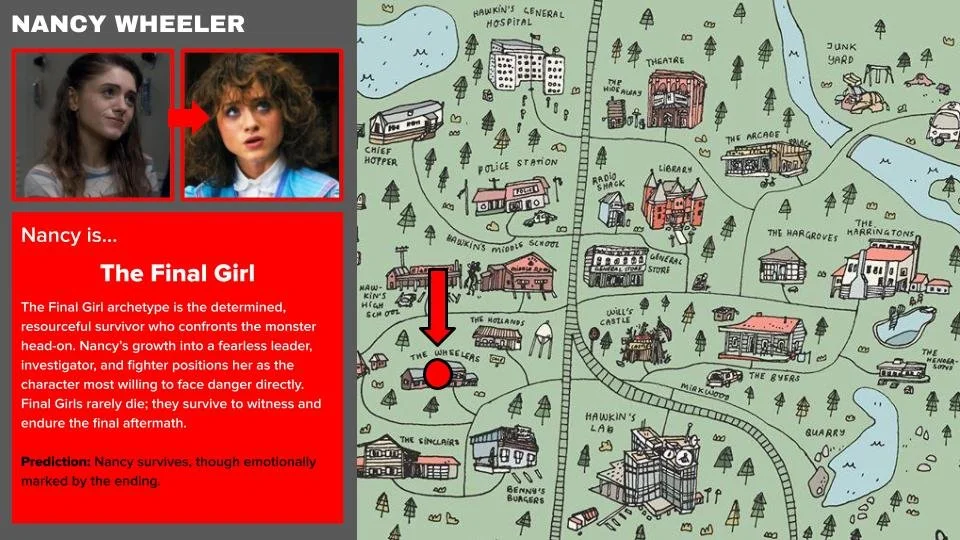
Nancy Wheeler: The Final Girl
Nancy practicing target shooting as she prepares for battle, Stranger Things Season 1
Nancy has one of the most consistent arcs in the series. She begins in Season 1 as a naive and bookish teenager pulled into a nightmare. When she hunts the Demogorgon with Jonathan, the show signals her transformation. Nancy becomes a classic Final Girl, a horror trope rooted in films like Halloween and Texas Chainsaw Massacre, where the intelligent, determined girl survives because she refuses to look away.
Season 2 strengthens this arc through her investigation into Hawkins Lab. Season 3 refines it as Nancy battles sexism in the newsroom and then proves everyone wrong by exposing the Mind Flayer’s return. By Season 4, Nancy is fearless, leading the charge into the Upside Down. She fires a shotgun directly at Vecna and stands her ground when others would freeze.
Season 5 Prediction: The Final Girl Who Survives
The Final Girl archetype rarely dies. They survive at great emotional cost. If Nancy lives through Season 5, she may end up isolated, carrying the burden of everything she has seen. Her survival will be symbolic but heavy. She may outlive the people she loves, especially if Steve or Jonathan die.
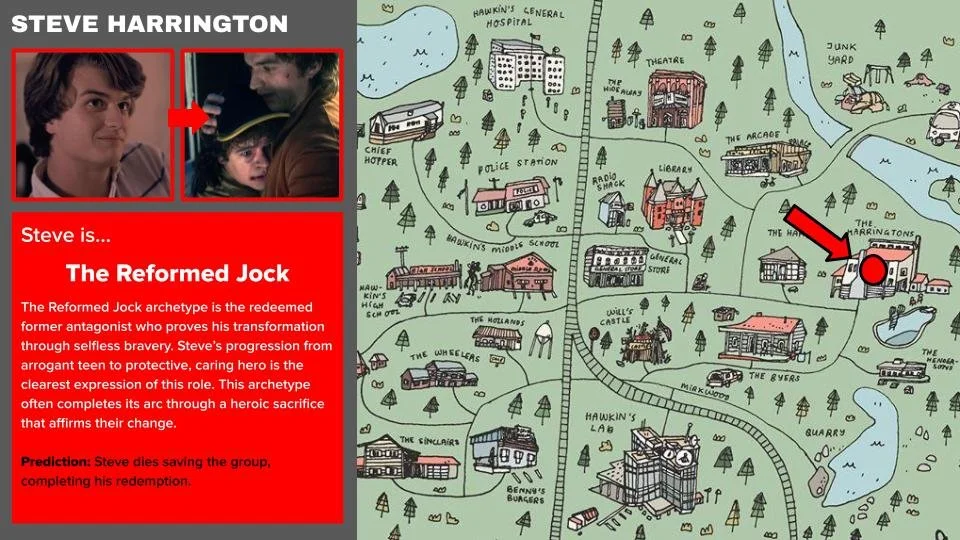
Steve Harrington: The Reformed Jock
Steve Harrington preparing to fight Demidogs with a nail bat, Stranger Things Season 2
Steve begins Season 1 as the stereotypical 80s jock but evolves into one of the show’s most beloved characters. His growth from shallow bully to heroic protector is complete by Season 2. He fights the demodogs with a nail bat, babysits the kids, and becomes the emotional safety net of the group. By Season 3, he is fully transformed, selflessly sacrificing ego for loyalty.
Season 4 emphasizes Steve’s heroism. He dives into Lover’s Lake without hesitation, fights monsters shirtless, and protects the group with increasing recklessness. Steve embodies the Hero’s Death trope, the character whose redemption arc ends in sacrifice. Films like Aliens, Terminator 2, and even Stranger Things itself with characters like Eddie follow this pattern.
Season 5 Prediction: The Redeemed Hero’s Last Stand
Because Steve’s arc is almost complete, he is one of the most likely deaths in Season 5. His death would devastate the fandom, but it would also complete his narrative. Steve no longer needs to grow. He only needs to save the people he loves.
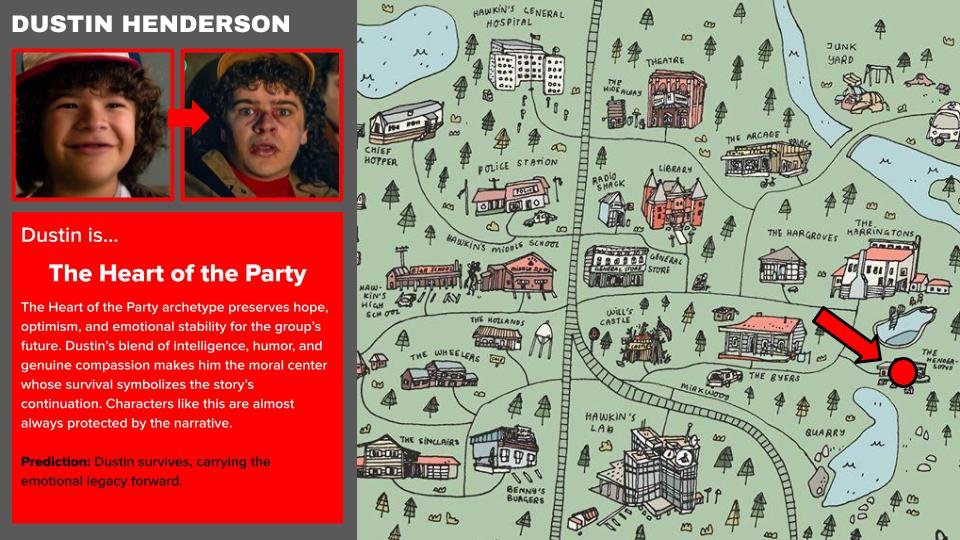
Dustin Henderson: The Heart of the Party
Dustin is the emotional glue of the group. His intelligence, humor, and optimism make him irreplaceable. Unlike Will or Mike, Dustin has not faced deeply personal horror. His grief over Eddie in Season 4 is the first major emotional break in his story. The fact that Dustin is still largely innocent in a narrative filled with trauma indicates his fate.
Season 5 Prediction: A Survivor Marked by Tragedy
Horror often preserves the heart character as a beacon for the future. Dustin may survive the final season, emerging as the legacy bearer. His role may be to honor Eddie’s name, rebuild Hawkins, or guide the next generation. Killing Dustin would break the emotional structure of the show without purpose. His survival would serve the story far more effectively.
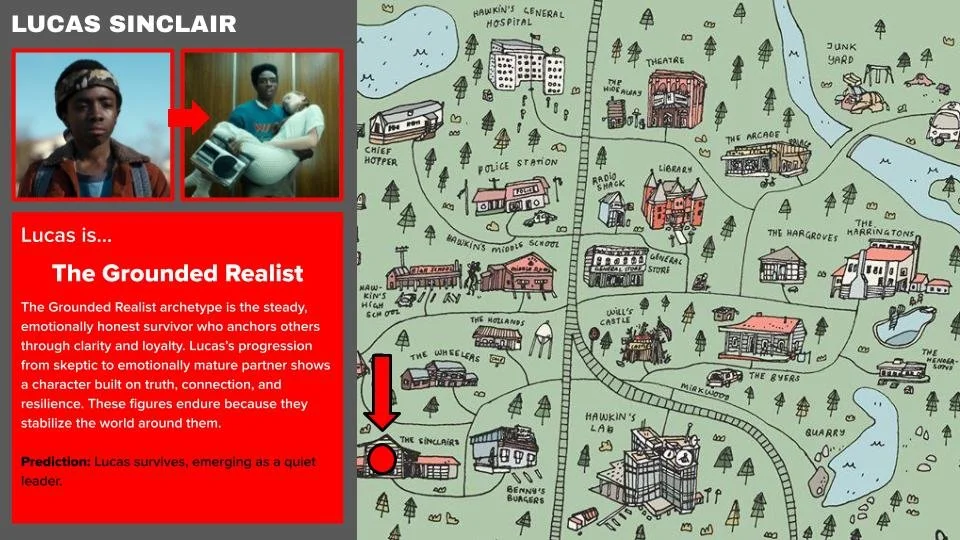
Lucas Sinclair: The Grounded Realist
Lucas has one of the most relatable arcs in Stranger Things. He begins as the skeptic, becomes the loyal friend, and transforms into the grounded realist. His relationship with Max becomes the emotional center of his story. Season 4 shows Lucas at his most mature. He tries to be a normal teenager but ultimately chooses loyalty over popularity. His desperate screams when Max dies in his arms are among the most heartbreaking moments in the entire series.
Season 5 Prediction: A Survivor Stepping Into Leadership
Lucas fits the Survivor archetype. He is rational, strong, determined, and emotionally anchored to the community. His survival feels thematically important. Lucas may rise as a quiet leader in the aftermath of Hawkins’ destruction.
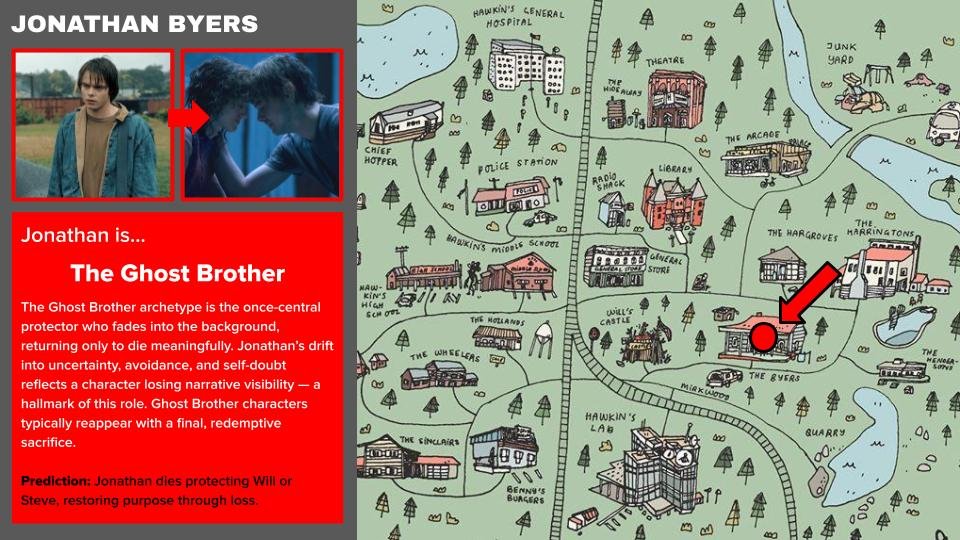
Jonathan Byers: The Ghost Brother
Jonathan enters the story as the protective older brother, the one who would do anything to save Will. His bond with his family is the core of his identity. By Seasons 2 and 3, he becomes Nancy’s partner in investigation and a moral compass within the group. However, Season 4 sidelines him, giving Jonathan scenes about uncertainty, avoidance, and fear of not being enough.
Season 5 Prediction: Redemption Through Loss
Characters who fade into the background often return later with sacrificial importance. Jonathan fits the Ghost Brother archetype, the overlooked but essential figure who dies to protect someone he loves. In many horror narratives, this character dies for the hero. Jonathan may sacrifice himself for Will, but an even more emotionally resonant choice would be saving Steve. Their rivalry, history of tension, and shared love for Nancy create a narrative symmetry that makes a Jonathan-for-Steve sacrifice devastating and poetic.
Final Prediction Recap: Who Lives, Who Dies, and Who Changes Forever
After mapping each character through their seasons, horror archetypes, and emotional evolution, here’s where we land for Season 5:
Predicted Deaths:
Will Byers – The Tragic Heart likely sacrifices himself to save Mike and confront Vecna directly.
Steve Harrington – The Reformed Jock may complete his redemption arc with a heroic final stand.
Possibly Hopper or Jonathan Byers – The Broken Protector and Ghost Brother arcs hint at a sacrificial ending.
Eleven? – While unlikely, her Weapon With a Soul archetype could result in a final, emotionally charged choice.
Survive but Changed:
Mike Wheeler – The Reluctant Hero grows into leadership and emotional clarity, shaped by tragedy.
Nancy Wheeler – The Final Girl endures, likely carrying the weight of loss and survival.
Max Mayfield – The Walking Wound survives physically, but her trauma may leave lasting scars.
Survivors:
Dustin Henderson – The Heart of the Party continues as the emotional and logical anchor.
Lucas Sinclair – The Grounded Realist stands as a potential quiet leader in the aftermath.
Written by Amelia Wilkes